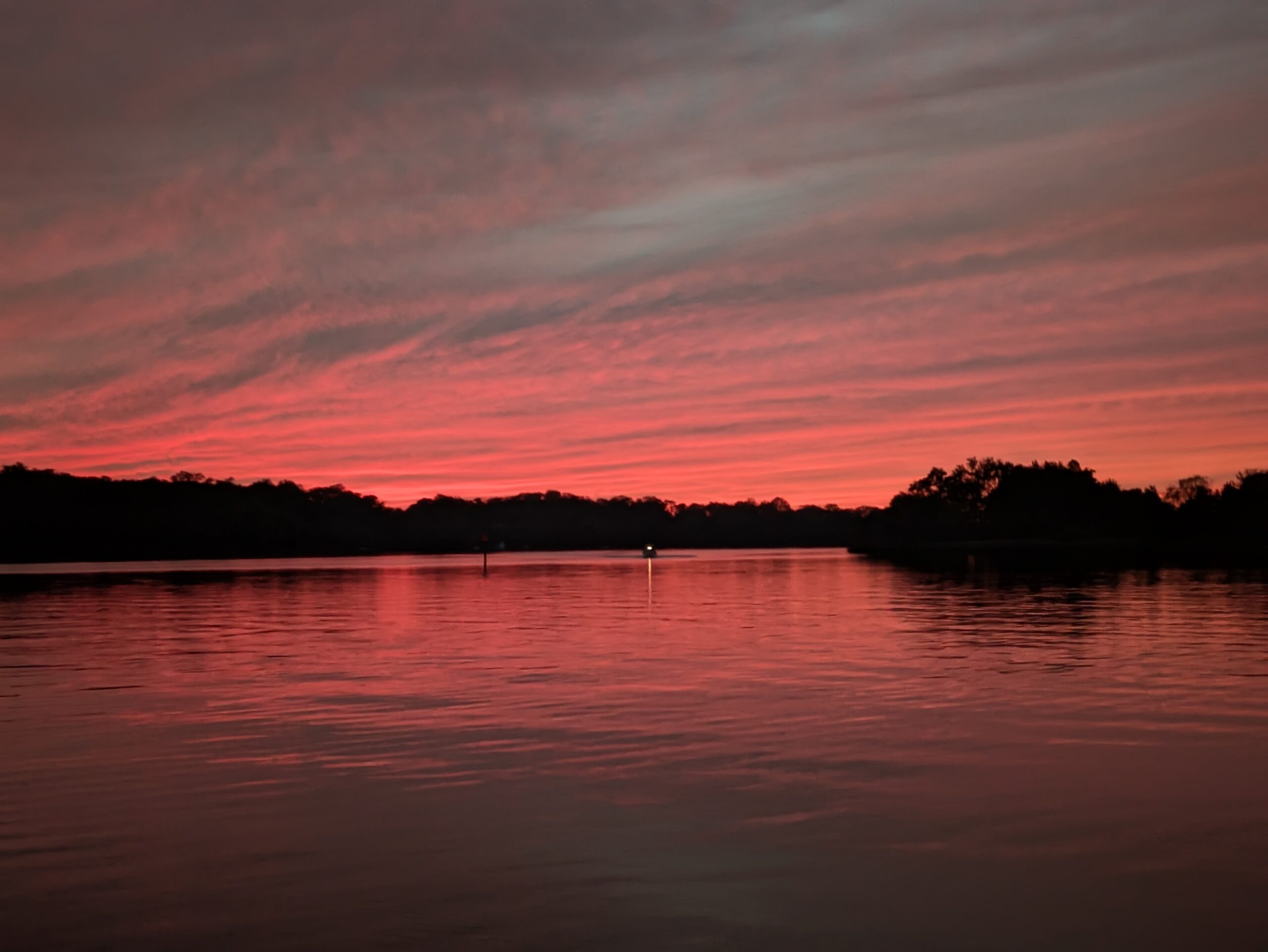
“This is still the world’s most enchanting inland water” – James A Michener
For all photos from this segment, see the google album HERE
95,000 years ago, the Laurentide ice sheet started receding from it’s furthest extent, uncovering New England from a long nap under 2 or more kilometers of ice. The movement and pressure of the glacier caused geologic power-washing of the rock and material underneath, and crafted much of the current Great Lakes, major eastern river courses, and also the rivers and bays of Maine.
Seemingly endless miles of peninsula, bay, river, and marsh; estuaries and tidal waters that extend miles deep into the heart of Maine. The coast of Maine seems endless at times, and indeed the dividing line of coastal water to inland waters can be vague and elusive. For a child of the Maine waters, much of the rest of the coast is exotic and alien, with vast sand beaches or impenetrable mangroves, rocky bluffs or development so thick it’s impossible to see anything but city.
Then, there is the Chesapeake.
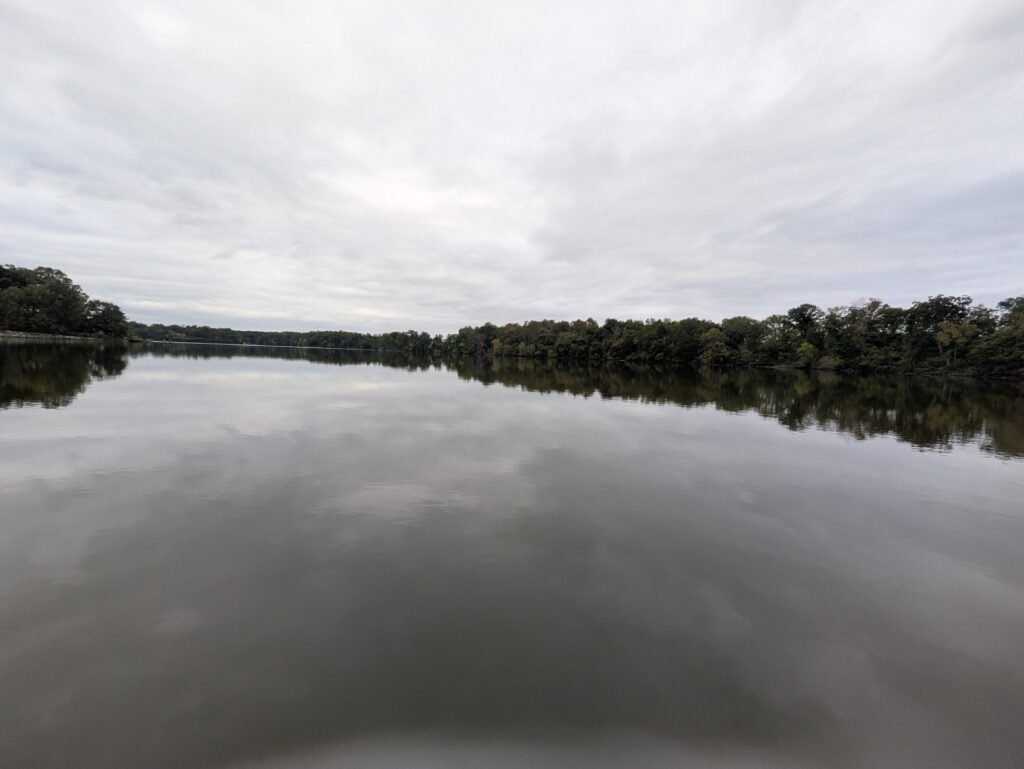
Carved by a mere few thousand years of erosion in the absurdly fertile mud and fine golden sand of Maryland and her neighbors, the bay itself is a river so large that it has escaped the definition and is more of a meeting point of seemingly countless smaller rivers and creeks. Miles and miles of river and bay and creek and estuarial tidal waters that meander deep back into the heart of Maryland and Virginia.
The Chesapeake feels, to me, like a homecoming – to a house that is subtly changed.
Riding the end of a spate of heavy sailing, I arrived in the Chesapeake with memories of childhood exploring and crab fishing, dreams of meandering creeks, and a friend who needed to catch a plane. So, despite being newly arrived in this muddy playground, first we needed to head for Baltimore. I mentioned getting Zach to his flight previously, so no more on that save to say: Thanks again, Z!
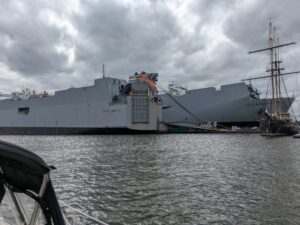
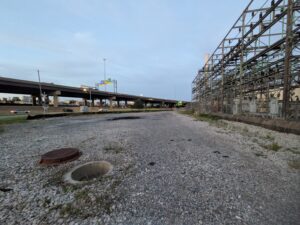
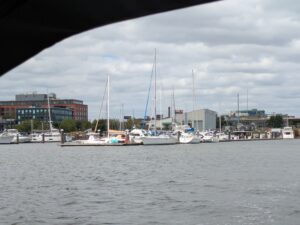
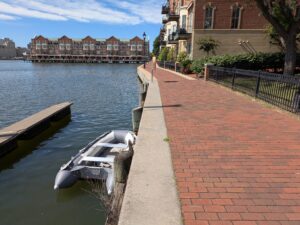
My stay in Baltimore ended up extended slightly by the arrival of the Nor’easter up the east coast of the US that looked like a hurricane on any weather map, bringing 40 mile an hour winds and torrents of rain to the exposed areas… which I was delighted to be far from. Baltimore was well removed from the worst of the action and a snug anchorage from which to do some projects and errands. All weather changes, however, and soon enough I was ready to set out and explore the bay.
My plan from the outset of this trip was to spend roughly a month in the Chesapeake, as I remembered it with an almost mystical fondness from the trip aboard Legacy. Memories and photos of exploring creeks in our dinghy, fishing for blue crabs with a chicken neck on a string, going ashore in little towns and swimming in the silty but warm waters. I was anxious to see if my memories would match the modern reality. What had the changing environment done? Were the quiet creeks developed? Were the waters empty of life, or recovering from the excesses of the 20th century?
Legacy had come in via the same canal I did, and then stayed in various places down the Eastern side of the bay; places like the Sassafras River, Swan Creek, and more. Much of it meant backtracking from Baltimore, but this portion of the trip was always about making memories, not miles.
Sassafras creek was in the memories list, so I pointed north toward the place I’d entered the bay. One night on the way in Still Pond and I had my first real introduction to the eastern side of the bay, as less than 300 feet from my anchorage was a bald eagle fighting a group of buzzards for a blue catfish at least 2 feet long. The bald eagle population of the Chesapeake is so robust, that every place I have dropped anchor on the eastern side came equipped with at least one nesting pair – I have woken to the call of eagles at least half the days in the bay.
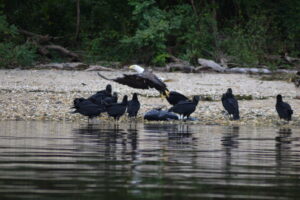
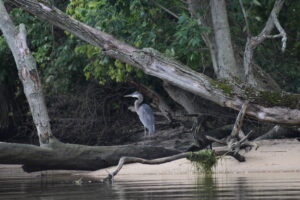
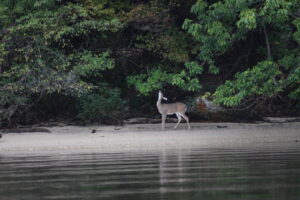
Jumping in for a swim in the Chesapeake – in places where the salinity is low enough that nettles (a form of stinging jellyfish) aren’t found – is a barely startling briskness followed by double checking to make sure you’re not in a lake. The smell, the look, the taste of the water on your skin is so barely salty that it feels impossible to have sailed here from the coast of New Jersey. Visibility is barely 2 feet at best, and the rich fine mud that makes up the bottom is perpetually in the water, lending a brown hue to the green of northern ocean. It’s not a clean feeling water, for all the lack of salt, and the earthy residue does make one want a rinse off – though the eastern bay bears none of the sulfur smell of Baltimore waters, and the amount of fish and sea birds are deeply reassuring. Nowhere that I anchored on the east side of the bay lacked for constant fish rise throughout the day and the evening.
The Sassafras river is a candidate for the Chesapeake tourism brochure… winding and placid, with occasional houses ranging from humble to palatial. Watermen – the catchall term for the Chesapeake’s working fishermen – work their boats throughout the day pursuing crabs, catfish, menhaden and more. Fish weirs – a forest of wooden poles along the shore with netting stretched between them – are around any given bend, and the depths where I can get out of the channel to anchor are solidly in the single digits. For a sailor from Maine, used to sailing in 60-300 feet of water and anchoring in 15-30, it’s a change of perspective to sail in 15-30 and anchor in 7-10 feet. Thankfully the 1-2 foot tides of the Chesapeake as opposed to the 9-11 feet of home make it easier to calculate where Selkie and I can get in, and where we should stay clear of. The charts are reasonably accurate, but the mud bottom (more forgiving when one does stray too far into the shallows) does have a sneaky habit of reworking itself in rains and storms, and a bottom that was comfortably 10 feet deep last month can shoal up to 4 or 5 feet following a good blow.
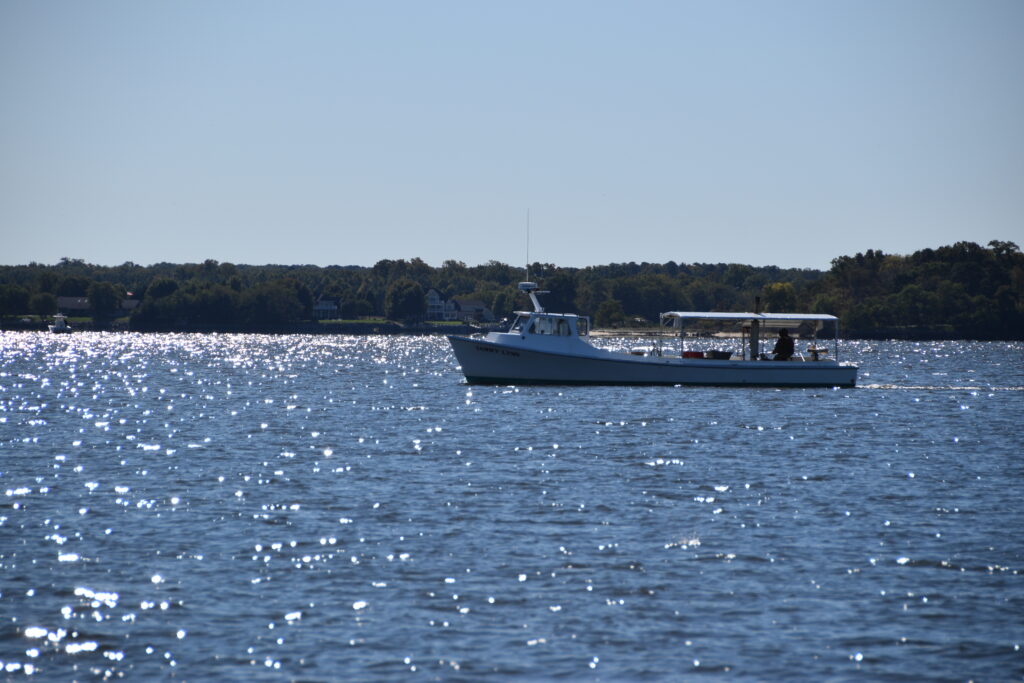
Some down-time at anchor meant I decided to try out the crabbing and fishing I remember from childhood. So, a partially eaten chicken thigh on a string, and a hand line baited with a bit of spam to see what bites.
I hauled in a crab nearly as large as my two hands, and a 12” long channel catfish within 15 minutes of setting both. Several more crabs followed, tho I stopped fishing for catfish because I can only eat so much and have no real space for extra storage. Clearly the overall population of aquatic life in the Sassafras was doing fine. I continued in to the farthest extent of the river I could go without crossing a swing bridge, and spent a couple of nights with a marina well back in a crook of the river that I would be very happy to face a hurricane hidden away in.
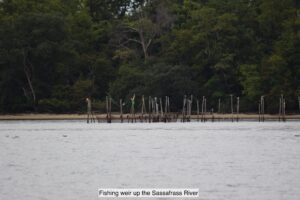
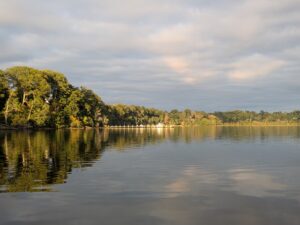
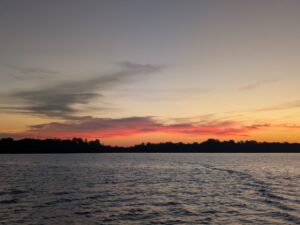
From there, I began what can best be described as a joyful pinball impression, crossing from east to west and back again, and visiting rivers and bays as far down as Annapolis. Chester River, Severn, Eastern Bay, West river, Choptank, Sassafras. I swam, I hiked, I came ashore in adorable towns and rode my bike to libraries and grocery stores.
But one experience stands out as truly emblematic of this trip:
The Corsica river is a tributary of the Chester, one of the medium-sized rivers on the eastern bay about at the same latitude as Annapolis. I had absolutely no reason to go into the Corsica, it just called to me, and so I worked my way carefully and slowly back into the winding and twisting waterway as far as the depth would let me – a number of miles in, but still about a mile and a half shy of Centreville MD, the nearest place to go ashore.
I set out my anchor in a little alcove of the river (able to get startlingly close to the shore) put everything to bed for a few days, and watched a couple in a small center console power boat putting out a line and buoys. When they were done, they came my way (initially I was worried I was in their fishing spot) to let me know that if I need to sail over the line, it was on the bottom and I could do so without an issue. We got to talking, and I discovered that what they were putting out was a “trotline” for blue crab fishing. Curious, I asked how often they checked it, and the guy said “We’re going to check it right now! …You wanna come?”
In improv acting, and in life, you get farther with “yes, and!” than “no, but…” and by god I “Yes’d!!” that offer in a heartbeat.
And so, I met Sean and Jackie – a cop and a 911 dispatcher from Delaware, and spent 3 hours fishing for crabs and drinking cheap local beer and having an unexpected and fabulous time. I had bought my recreational crab license along with a fishing license when I left Baltimore, meaning I could take up to a bushel in my boat, and between us we filled their bushel basket and a 5 gallon bucket for me with ease. I dipped, spotted, drove some, and honestly enjoyed some beer I typically turn up my nose at (Natural “Natty” light) showing that we should always poke our prejudices from time to time.
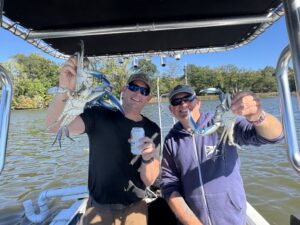
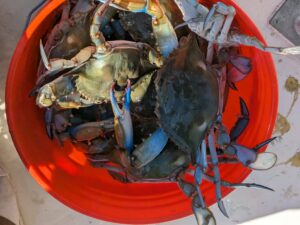
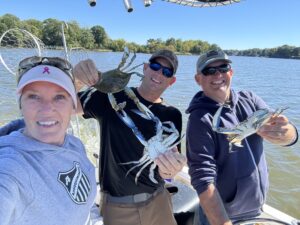
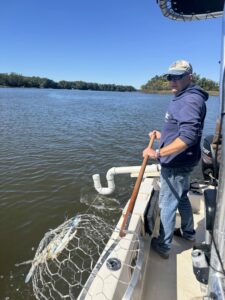
The way a “trotline” works, is you take about 400 feet of 1/4” line and every 6 feet or so is a smaller line about 12” long hanging off it. To each of these is tied a chicken neck, or a decent piece of one. (Where do you get 60+ chicken necks? Walmart… at least in the Chesapeake) On each end of the trotline is an anchor weight and a buoy, and you stretch it out on the bottom between the two anchors. On the side of the boat is a PVC contraption called an “arm” which has a bit of a U bend, and to run the line you drive to one end, lift the line over the arm, and then very slowly drive along the line, which pulls it from the bottom and up over the arm. As it rises, the blue crabs cling to their prize and are lifted to the surface, where you snag them with a long handled net and pop them into the bushel basket. You have to be quick tho, because if the crabs break the surface they let go and swim away… blue crabs are remarkably fast swimmers.
I have not seen as many crustaceans in one place at one time since hanging out with professional lobster guys in Boothbay in the late 90s. It was wild. Run the line, wait 10 minutes, run it again. Repeat. We caught well over a hundred crabs, and I took home so many that I ate my fill that night, picked over a pound of meat, and tossed another 8 back because I was simply done dealing with crabs. (The locals are right, the meat tastes more like crab if you use Old Bay or some similar seasoning. As a test, I tried my lobster method of just a clove of garlic, and the taste wasn’t the same)
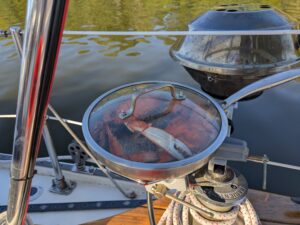
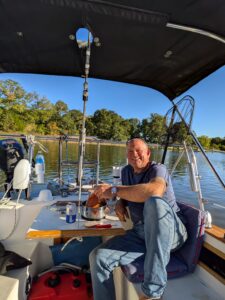
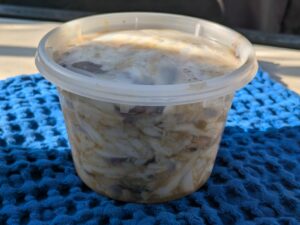
I am delighted to say that lobster skills translate very well to blue crabs, by the way.
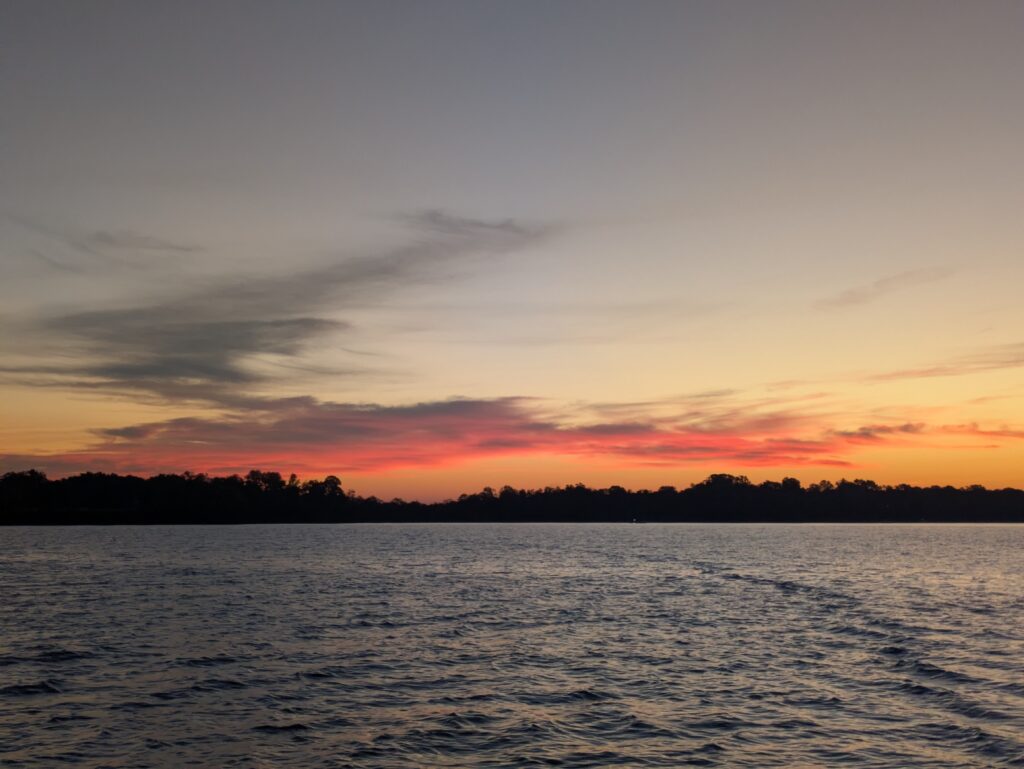
Unexpected delights and new experiences around a bend in the river. New tastes and the subtle essence of silt and fertile earth on your tongue. Smells and sounds and a blend of the rich and the poor, the industrial and the natural. Slow sunsets, gravid moons, and chilly nights as autumn sets in. Such is the Chesapeake.
My time here cannot be forever, and in many ways it’s a blessing to feel the tendrils of winter begin to creep along the banks – I’ve broken the down comforter and the small propane heater back out of storage for nights well into the low 40s. The tide ebbs and fills, and the days pass on, and the next legs are still to come. Next stop is up the Potomac and into DC for a few days and a shore bound SCA event… but for now, the close of a day on the Chesapeake is enough.
Leave a Reply