But where, after all, would be the poetry of the sea were there no wild waves?”
– Joshua Slocum
To see all photos from this period, see the July 2026 album.
July is prime sailing month in the gulf of Maine; it also happens to be the month when ALL of my camping events and one of my annual industry network events happen. That didn’t stop me from getting some time with some friends and even connecting a sail AND my Industry networking event.
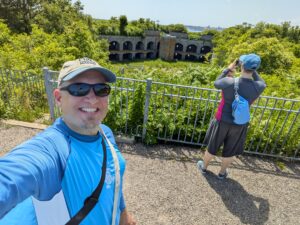
Right out of the gate on the 2nd of July was having my partner Eliska aboard and getting out and about in the harbor, amazingly I had never taken her to Fort Gorges!
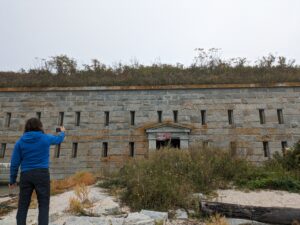
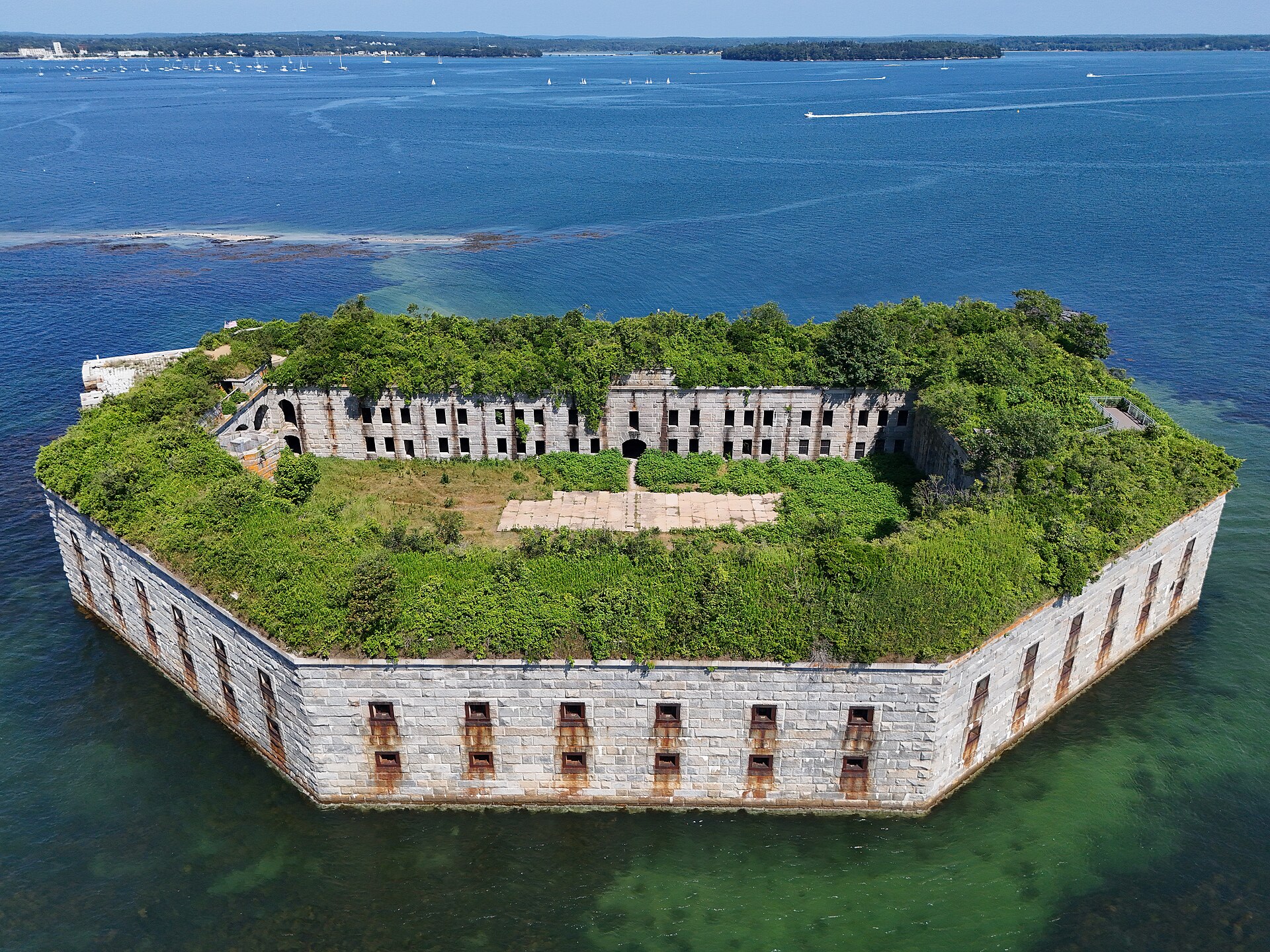
For those who missed it in a previous post, Fort Gorges in Portland Harbor is a 19th century fort built for the American civil war, which found itself left in the dust by technology. Built to allow the short-range cannon of the mid 19th century to coordinate with batteries on Spring Point and House Island, thus protecting the entry points to an important Northern harbor, Fort Gorges was nearly finished when the long-range cannon was invented.
Owing to the difficulty of supporting a military installment on an island and the availability of the battery on Spring Point to now dominate the harbor, Fort Gorges entered a period of alternate uses. Never garrisoned, but manned by small groups of officers and a family of caretakers, the fort stored naval mines during the 1st world war, and was ultimately abandoned in the middle of the 20th century. It’s a rare example of an essentially unused ruin.
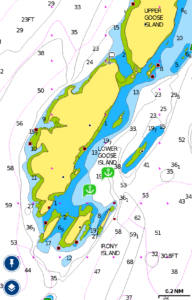
Eliska and I spent the day exploring the ruins, going for a swim, and then heading further north to one of my favorite anchorages at The Goslings and Goose Island. Up in Harpswell Maine the small Goslings are public access islands with a restricted inner portion during parts of the year to support the nesting Osprey population, but a number of moorings (that can generally be borrowed) and space for 4 or 5 boats to anchor mean an easy entry.
We grilled dinner, swam to cool off, and watched the sun set, then in the morning went for another swim and took Pup ashore so we could snorkel in the shallow sand bar space between the islets. The sardines were running in the tens of thousands, turning the water around and between us into a sparkling thundercloud of ever-changing light and dark, and moving like a river inside the ocean. The mackerel, terns and seagulls were making a fine and lazy meal of them everywhere we looked.
A nice motor sail back to Portland, tho we had to heave to (a boat’s version of double parking) for a few while I went down to figure out why the engine wasn’t passing water any more… turned out there was a piece of seaweed in the intake port. The seawater intake on Selkie has been a weak point for years and I’m seriously considering swapping it out for a bigger one when I haul her and repaint the bottom.
Why does the engine need seawater? Instead of having an air-cooled radiator for the coolant to circulate (like your car) the boat’s engine is in a compartment below and would be hard to get enough air to. Instead the engine has a system that pulls in seawater and runs it across a version of the radiator, thereby cooling the engine coolant down, and then it spits the water back out using the force of the exhaust pipe. It’s a slick system, but the intake port on Selkie is only 1/2” in diameter… juuuust the right size for a float bladder on a piece of rockweed to 90% block it. (I had to remove the intake hose and jam a chopstick down through the pipe to dislodge it, then hook everything back up – while the ocean ran in through the hole. Excitement!)
Once we were back in harbor and I got Eliska on her way, I swung around and picked up Casey – one of the students from my fencing school – and her girlfriend Taylor, for an evening on the water. We sailed out into the ship channel, anchored off Fort Gorges, watched the sun set, grilled dinner, and then I dropped them off at the public landing under a rising full moon.
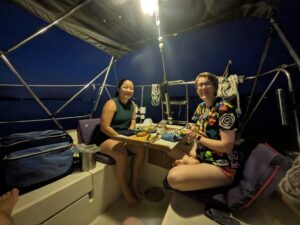
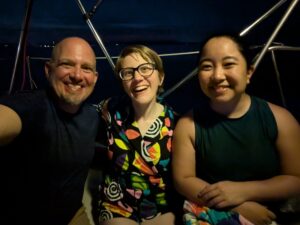
The next day – we’re only to July the 4th here – I picked up my friends Hannah and August, and took them both out for a daysail and to explore Fort Gorges. (It’s a popular place for me to bring people, there’s even this giant dark old powder magazine you can explore… and this time, there were BATS for the first time that I’ve seen out there. Oh, I also brought my geiger counter just out of curiosity and yeah… granite and brick structure… maybe don’t like MOVE IN.)
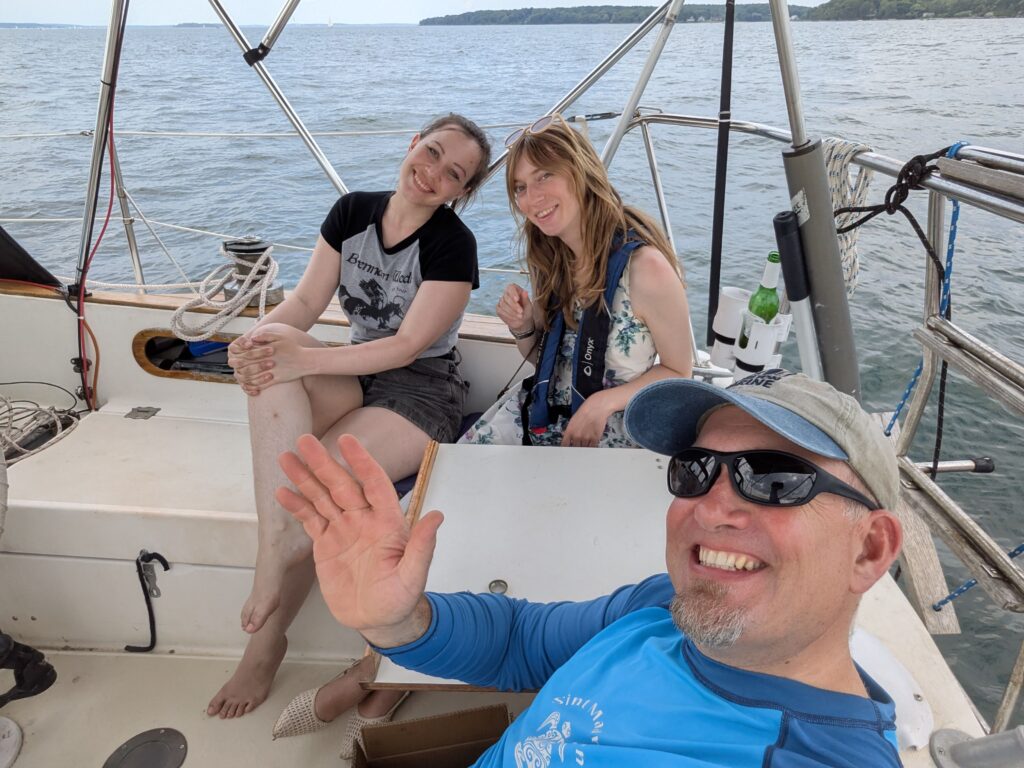
We watched the fireworks from the mooring at the Yacht Club, and then I got them on the way and packed up Selkie for a little more than a week ashore, including one of the two camping events of the summer, the SCA’s Great Northeastern War.
Making a detour ashore but still all about boats, my friend Patience and I visited the tall ships at dock in Boston Harbor, waiting in line for a bit to go aboard the Italian state ship the Amerigo Vespucci to tour her sheer gorgeosity. I love Selkie, and many other ships, but can say that the Vespucci is simply the most beautiful vessel I’ve ever been aboard. The woodwork, the brasswork, the lines and the sails… it’s a masterpiece. I asked one of the officers how often they have to pumice stone the decks, and he said that (the cadets) do so every “two or tree day.” Yowzers. That’ll keep the cadets out of trouble.
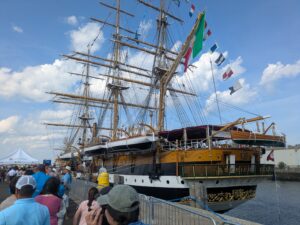
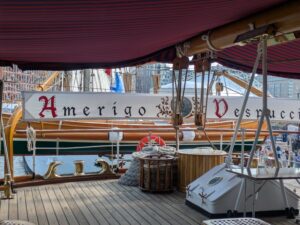
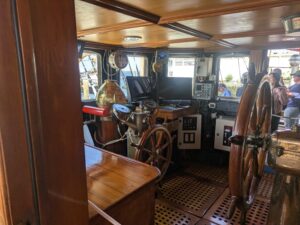
BoatNote: The decks of classic wooden ships are (generally) teak, and they are unfinished because to finish them makes them dangerously slippery. As a result, they weather, and have to be swabbed (mopped) every day to keep them hydrated, otherwise they will shrink and leak water from rain and spray below. Also, because this causes the grain to lift, the decks have to be sanded – classically with a pumice stone – every so often. In this case… every two to three days.
The weekend of the 17th I was back aboard, and sailing once more north to Boothbay Harbor, for the annual Audiofile Magazine lobster bake. This has been happening for ages, where one weekend in mid-July Robin and Rob Whitten (Robin is the founder of Audiofile) welcome narrators and industry people to their DEFINITION OF BUCOLIC cottage on Ocean Point in East Boothbay. It’s an incredibly relaxed gathering with good food and drink and general camaraderie.
It also happens to occur about a mile from one of the houses I grew up in, and the house from which we left on the original version of this adventure. (Ages 5-9. Long story, my parents moved a lot. I think my dad had itchy feet)
I’d been going to the Audiofile event for several years and saying that I really needed to sail there one of these times, and the summer of 2025 I followed through on my promise. Since this year I am sailing off into greater adventures, it seemed foolish not to repeat the move.
I sailed north to Boothbay through some rather spicy squalls, and made harbor Thursday night, then spent the day Friday doing some projects on the boat. Friday evening we always have a pre-game get together, which was charming as always, and then Saturday morning I sailed around the peninsula to the site in front of their cottage.
The weather was squally again, and I made a mistake in going too close to where I knew there was a rock, but was focused on looking for the best spot to anchor. I whacked the rock with the keel and worse yet, felt it hit the rudder skeg (a protective vertical fin the rudder is mounted too) and heard/felt a little “ripping” sound.
Now, as an experience sailor, I can tell you that “ripping” sounds are not what one wants to hear.
I did the appropriate swearing and fretting, got anchored, threw on my wet suit and mask and went to check out the damage. Dinged up the leading edge of the keel, not badly… but I tore off a hunk from the very bottom of the skeg, below the gudgeon for the rudder. Thankfully the rudder seems intact and working fine, so it looks like the portion I broke was mostly for streamlining. Phew, and also FOR the LOVE.
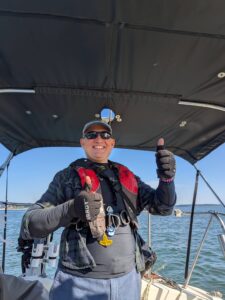
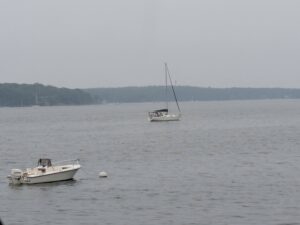
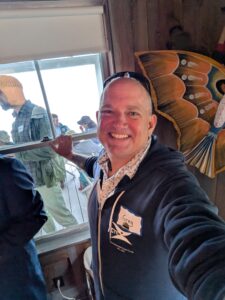
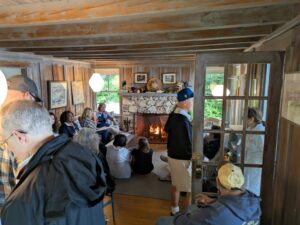
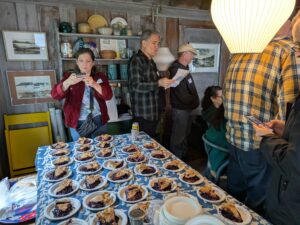
Enjoyed the day, practiced some active compassion with myself for making a mistake, and after a night in a nearby cove, sailed south once more.
The sail south was, if possible, even spicier than the sail north… with winds hitting 35 knots and sailing under reefed main and headsail the whole way. Some good practice with Selkie’s reefing systems and getting things even more smoothly set up, so some good came of it all!
BoatNote: “Reefing” is the practice of reducing the size of a sail so that the force applied to it by the wind is only the amount needed to move the boat forward, and minimizes the extra pressure that makes the vessel hard to steer, and want to lean way too far over for comfort and safety. The main sail (the one on the mast – the vertical pole) gets reefed by taking in one of three lines (small, medium and large reef) and shrinking it down on the boom (the horizontal pole) where the excess sail just kinda sits in a floppy pile. The headsail (the one at the front) gets reefed by rolling up around itself like an old style pull down blind. The more I let out, the bigger the sail “engine” is.
Selkie, as a sailboat, assumes that her diesel engine is the auxiliary, and the sails are the primary moving force; indeed, Selkie can move faster with her sails than she can with the engine. The “hull speed” (practical maximum speed) Selkie can it is 7.5 knots… and while I can easily do that in 12-15 knot winds, there is no way the engine can push her that fast. 5 to 5.5 knots is where the engine tops out. While she is pretty fuel conscious (Selkie uses about 4.5 gallons of fuel in a 12 hour day under power) I still vastly prefer to sail wherever and whenever I can. Both for the environment and because I love sailing.
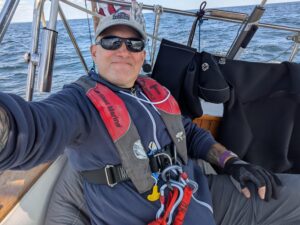
Safely back in Portland at last, it was time to tidy Selkie up and get ready for 2 weeks of camping with friends at the Pennsic War in Butler PA. When I return it will be the last big push before departure, with a haul-out, painting, minor repairs (oops) and an upgrade to the raw water intake.
But first… the modern Middle Ages await!
{Photo of Fort Gorges from the air, courtesy of Wikimedia:
Quintin Soloviev – Own work, CC BY 4.0, https://commons.wikimedia.org/w/index.php?curid=171349790}
Leave a Reply